DevOps Services by Bhavantu Software: From Development to Reliable Delivery
Building software is only one part of delivering a successful application.
Once an application is developed, it still needs to be tested, packaged, deployed, monitored, updated, and maintained. When development and operations work separately, these activities can become slow, repetitive, and difficult to manage.
This is where DevOps becomes valuable.
At Bhavantu Software, we use DevOps practices to bring development and operations closer together, helping teams deliver software through more consistent and repeatable processes.
Whether the application is an ERP system, CRM platform, web application, desktop solution, API, or mobile-connected business application, a well-planned DevOps approach can make deployment and ongoing software management more organized.
The goal is not simply to deploy software faster. It is to create a process that teams can repeat, maintain, and improve as the application evolves.
What Does DevOps Actually Change?
Traditionally, development and operations can work as separate activities.
Developers write the application.
Operations prepares the environment.
Deployment happens later.
When something changes, the process may need to be repeated manually.
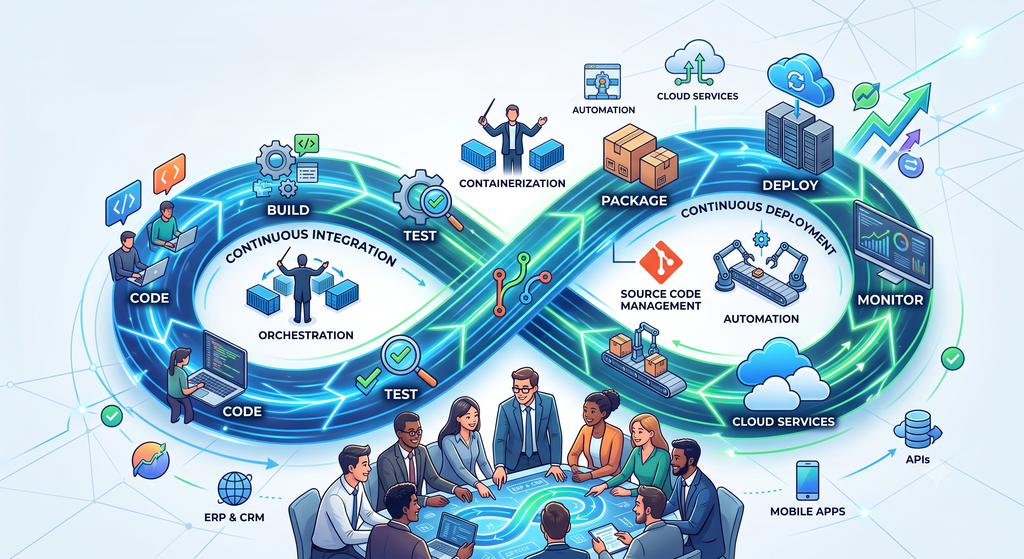
DevOps brings these activities closer together through collaboration, automation, source control, standardized environments, and repeatable deployment processes.
A typical flow can look like:
Code → Build → Test → Package → Deploy → Monitor → Improve
This makes software delivery a continuous process rather than a sequence of disconnected tasks.
Our DevOps Services
Bhavantu Software provides DevOps services around the core areas required to manage modern application delivery.
Containerization
Applications often behave differently across development, testing, and production environments.
Containerization helps package an application together with the components it needs to run consistently.
This can help teams create more predictable application environments and simplify deployment across different systems.
For business applications such as ERP and CRM, containerized environments can also make it easier to maintain consistent application setups across development and production.
Orchestration Services
As applications become larger, managing multiple containers and services manually can become difficult.
Orchestration helps manage these application components in a more structured way.
Depending on the application’s architecture, orchestration can help with areas such as:
- Service management
- Application deployment
- Scaling
- Environment coordination
- Recovery processes
- Resource management
The appropriate orchestration approach depends on the size and requirements of the application.
Managing Source Code Properly
Source code management is one of the foundations of reliable software development.
When several developers work on the same project, teams need a consistent way to manage changes, track versions, collaborate, and maintain previous code states.
Bhavantu Software’s DevOps practices include structured source code management to support:
- Version control
- Team collaboration
- Change tracking
- Code history
- Branch management
- Controlled releases
This gives development teams better visibility into what changed, when it changed, and how those changes move toward deployment.
Automation: Reduce Repetitive Deployment Work
Manual deployment can take time and introduces opportunities for mistakes.
A developer may need to repeat the same steps every time a new version is released:
Build → Copy Files → Configure Environment → Deploy → Restart Services → Verify
DevOps automation can turn these repetitive steps into a consistent process.
Automation can be applied to areas such as:
- Application builds
- Testing processes
- Packaging
- Deployment
- Environment setup
- Release workflows
- Routine operational tasks
This allows teams to spend less time repeating deployment steps and more time improving the application itself.
Cloud Services
Modern applications increasingly run on cloud infrastructure.
Bhavantu Software works with cloud services to support application deployment and infrastructure requirements according to the project.
Cloud environments can provide businesses with options for:
- Application hosting
- Scalable infrastructure
- Database services
- Storage
- Networking
- Deployment environments
- Backup and recovery
The right cloud architecture depends on factors such as application size, expected usage, security requirements, integrations, and business objectives.
DevOps for ERP and CRM Applications
Business applications such as ERP and CRM systems are rarely “finished” after the first release.
New requirements continue to arrive.
A company may need:
- A new ERP module
- A CRM feature
- A report update
- An API integration
- A mobile application change
- A database modification
- A security improvement
Each change needs to move safely from development into production.
A DevOps approach can help create a more consistent path for these updates.
For example:
Developer Changes → Source Control → Automated Build → Testing → Deployment → Production
This is particularly useful for applications that receive frequent updates.
Why Repeatability Matters
A deployment process that works only when one particular person performs it can create operational dependency.
A repeatable process is easier to understand, maintain, and hand over.
DevOps encourages teams to document and automate deployment activities so that releases follow a defined process rather than relying entirely on manual steps.
That can make application management more predictable as the team and project grow.
DevOps Is More Than Automation
It’s easy to think of DevOps as simply a collection of tools.
In reality, DevOps is also about collaboration and process.
Development and operations need to work toward the same outcome:
Reliable software delivered through a consistent process.
That means communication, source control, testing, deployment practices, infrastructure management, and continuous improvement all play a role.
Tools support the process, but the process itself matters just as much.
Where DevOps Fits Into the Software Lifecycle
DevOps can support different stages of the application lifecycle:
Development
Developers work with source control and shared development practices.
Testing
Application changes move through repeatable testing processes.
Packaging
The application is prepared for deployment in a consistent environment.
Deployment
Releases move through a defined deployment process.
Operations
The application runs within the intended infrastructure and environment.
Improvement
Teams continue making changes based on business requirements and operational needs.
This creates a more connected software lifecycle.
Why Bhavantu Software?
DevOps works best when it supports the application rather than becoming a complicated layer around it.
Bhavantu Software combines software development with DevOps practices, allowing us to consider development and deployment requirements together.
Development + Operations
Our teams can consider deployment and operational requirements during development rather than addressing them only at the end.
Practical Automation
We focus on automating repetitive tasks where automation provides clear value.
Consistent Environments
Containerization and standardized deployment processes can help reduce differences between environments.
Scalable Approach
DevOps practices can be adapted according to application size, team structure, and infrastructure requirements.
Cloud-Ready Solutions
Cloud services can be incorporated where they make sense for the application’s technical and business requirements.
Long-Term Support
DevOps isn’t only useful during the first deployment. It can support ongoing releases, maintenance, and application improvements.
When Should a Business Consider DevOps?
DevOps can become particularly useful when a business:
- Deploys applications frequently
- Has separate development and operations responsibilities
- Relies heavily on manual deployment
- Manages multiple environments
- Needs more consistent releases
- Runs containerized applications
- Uses cloud infrastructure
- Maintains ERP, CRM, or other continuously evolving applications
The level of DevOps required should match the complexity of the application rather than adding unnecessary processes.
Areas We Serve
Bhavantu Software provides DevOps and software development services to businesses across India, including Gujarat, Maharashtra, Rajasthan, Punjab, Haryana, Uttar Pradesh, Madhya Pradesh, Karnataka, Telangana, Tamil Nadu, Kerala, Odisha, West Bengal, Assam, Bihar, Andhra Pradesh, and other regions.
Our DevOps services can support organizations running ERP, CRM, web, desktop, API, mobile, and other business applications.
Frequently Asked Questions
What is DevOps?
DevOps is an approach that brings development and operations closer together through collaboration, automation, source control, standardized processes, and repeatable software delivery.
What DevOps services does Bhavantu Software provide?
Our services include containerization, orchestration, source code management, automation, and cloud services.
Can DevOps be used for ERP and CRM applications?
Yes. DevOps practices can support ERP, CRM, web, API, mobile, and other applications that require regular development, testing, and deployment.
How does containerization help?
Containerization packages applications and their required components into consistent environments, helping reduce differences between development, testing, and production setups.
What is orchestration?
Orchestration helps manage multiple application containers or services in a structured way, including deployment and resource management.
Can DevOps reduce manual deployment work?
Yes. Repetitive activities such as builds, testing, packaging, and deployment can be automated where appropriate.
Do you provide cloud-based DevOps services?
Yes. Cloud services can be incorporated into application and deployment environments based on the project’s infrastructure and business requirements.
Is DevOps only for large companies?
No. DevOps practices can be adapted to smaller projects as well. The level of automation and infrastructure should match the application’s actual needs.
Build It Once. Deliver It Consistently.
Software development doesn’t end when the code is written.
The application still needs a reliable way to move from development to production and continue evolving after release.
Bhavantu Software’s DevOps Services bring together containerization, orchestration, source code management, automation, and cloud services to support a more consistent software delivery process.
Whether you’re developing a new business application, maintaining an ERP or CRM platform, or moving an existing application toward a more automated deployment environment, DevOps can provide the structure needed to manage software more effectively.
Let’s Improve the Way Your Software Is Delivered
Tell us about your current development and deployment process, the challenges your team faces, or the application you’re planning to build.
Contact Bhavantu Software to discuss your DevOps requirements and explore a practical approach for your software environment.
For more details and a personalized consultation, visit our Services!
Contact No: 9099825657
Email: sales@bhavantusoftware.com